
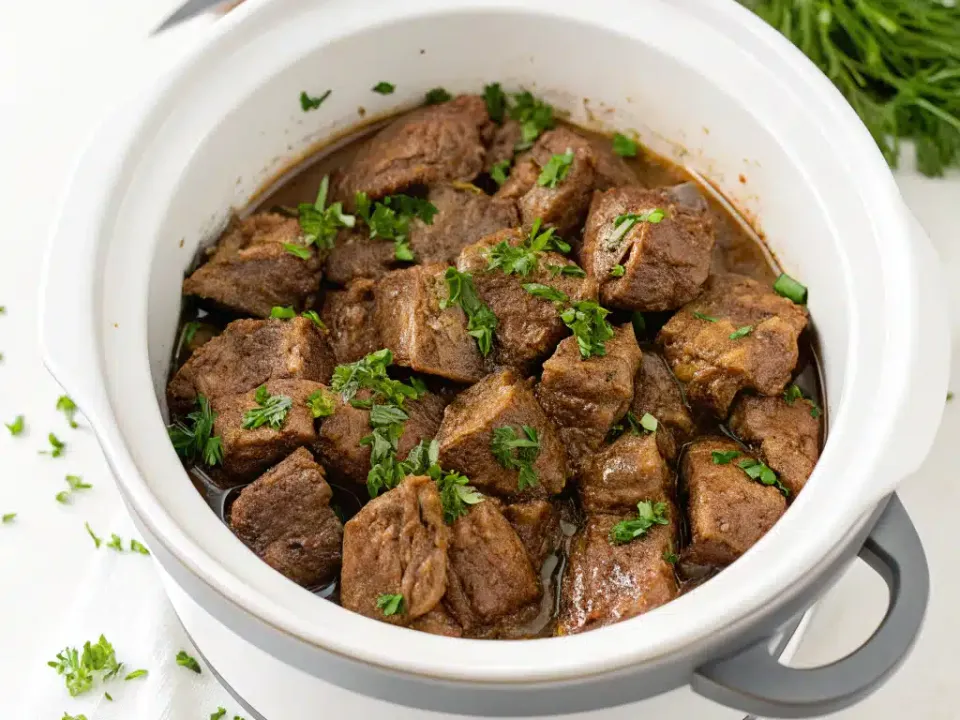
Beef tips are cubes of beef braised until tender and served in their own gravy, usually over mashed potatoes or noodles. The gravy is where wheat normally hides, so this version replaces it in three places and thickens with a cornstarch or arrowroot slurry instead.
Nothing else about it is unusual. Cubed beef, sliced onion, cremini mushrooms, and seven to eight hours on LOW. The last half hour is the only part that needs you.
The Three Swaps
A conventional beef-tips gravy contains wheat in three separate places, and none of them are obvious. These are the substitutions the recipe names.
| In the recipe | Usually | Here | Why it matters |
|---|---|---|---|
| The thickener | A flour roux | Cornstarch or arrowroot slurry | Flour is the usual way to thicken a beef gravy. The slurry goes in at the end instead, and arrowroot is an equal alternative. |
| The savoury sauce | Standard Worcestershire | Tamari, or certified gluten-free Worcestershire | Worcestershire is commonly made with malt vinegar from barley. Tamari is the simpler swap, and if you use Worcestershire it must be 'certified'. |
| The broth | Standard beef broth | Gluten-free beef broth | Commercial broths often carry wheat as a thickener or flavouring. Use a gluten-free broth by name rather than leaving it to chance. |
Why This Recipe Works
- The beef is seasoned before anything else touches it. Salt, pepper, onion powder, garlic powder and smoked paprika are tossed through the cubes at step 1, so the seasoning is on the meat rather than floating in the liquid.
- Cubes rather than a roast. Stew meat or sirloin tips give far more surface area than a whole roast, which is why this recipe reaches tender in six to eight hours and why it halves so cleanly.
- The slurry goes in at the end and cooks on HIGH. Twenty to thirty minutes is a longer window than most slurry steps, because a slow cooker on HIGH is a gentler heat than a saucepan on a hob.
- Tomato paste is in the liquid, not on the beef. Whisked with the broth and tamari at step 4, it adds colour and background savouriness without needing to be fried first.
How to Make It
Season the beef
Toss the cubes with salt, pepper, onion powder, garlic powder and smoked paprika until evenly coated.
Sear, optionally
Olive oil in a hot skillet, beef browned in batches, then transferred to the crockpot. Step 2 marks this optional.
Add the vegetables
Sliced onion, sliced cremini mushrooms and minced garlic go in with the beef.
Mix and pour the liquid
Whisk the gluten-free broth, tamari or certified gluten-free Worcestershire, and tomato paste with the thyme and rosemary, pour it over, and add the bay leaves.
Slow cook
LOW for 6–8 hours or HIGH for 3–4, until the beef is fork-tender.
Thicken in the cooker
Stir the cornstarch or arrowroot slurry straight in, turn to HIGH, and give it 20–30 minutes until the gravy thickens. Butter or ghee goes in here if you want it.
Finish and serve
Remove the bay leaves, scatter with parsley, and serve over mashed potatoes, rice or gluten-free noodles.
Thickening Without Flour
A roux needs fat and flour cooked together before liquid goes in. A slurry works the other way round: starch dispersed in cold water, stirred into hot liquid, then held at heat until it sets. That is why step 6 turns the cooker to HIGH rather than leaving it on LOW.
Twenty to thirty minutes sounds long next to a stovetop gravy, and it is — a slow cooker on HIGH sits below a simmer, so the starch takes longer to reach the temperature at which it thickens. Resist adding more slurry before the time is up.
Arrowroot behaves slightly differently from cornstarch: it thickens at a lower temperature and goes clearer rather than opaque. Both are listed, and either is correct.
Here the gravy is thickened in the pot rather than strained into a saucepan, which keeps the mushrooms and onion in it.
Ingredient Notes
- Beef stew meat or sirloin tips
- 2.5 lb, trimmed and cubed. The two are interchangeable. Stew meat is usually chuck and needs the full time; sirloin tips are leaner and reach tender at the shorter end of the range.
- Cornstarch or arrowroot
- 3 tbsp with 3 tbsp cold water. Arrowroot is the alternative; both are naturally gluten-free, and cold water is what stops either from clumping.
- Tamari
- 2 tbsp, or certified gluten-free Worcestershire. Tamari is a soy sauce brewed without wheat, which is why it appears here rather than ordinary soy sauce.
- Butter or ghee
- 2 tbsp, optional. Use a dairy-free alternative if needed, so the recipe can be finished without dairy as well.
- Smoked paprika
- 1 tsp, in the dry seasoning. It is the only smoky element in the recipe and does a lot of the work that browning would otherwise do.
Success Tips
- Read the broth label. This is the swap most easily missed, because a beef broth gives no reason to suspect wheat.
- Sear in batches if you sear at all — crowded cubes steam, and 2.5 lb will not fit one skillet in a single layer.
- Crush the dried rosemary. Whole needles stay whole and are unpleasant to bite into.
- Stir the slurry in properly rather than pouring it in one spot, or you will get a thick patch and a thin pot.
Serving Ideas
Serve it over mashed potatoes, rice, or gluten-free noodles, finished with chopped parsley.
Storage and Reheating
Refrigerate
Refrigerate the beef in its gravy in a sealed container. The gravy sets firmer when cold, which is normal for a starch-thickened sauce.
Reheat
Reheat gently with a splash of broth or water. Starch-thickened gravies can turn thin if boiled hard after chilling, so keep it below a rolling boil.
Frequently Asked Questions
Why can I not just use normal Worcestershire sauce?
It is commonly made with malt vinegar derived from barley. Use either tamari or a certified gluten-free Worcestershire, and 'certified' is the operative word — formulations vary by brand.
Cornstarch or arrowroot — does it matter?
They work as equals. Arrowroot thickens at a lower temperature and gives a clearer gravy; cornstarch is more common and gives a slightly opaque one. Use the same quantity either way.
My gravy is still thin after twenty minutes. What now?
Give it the full thirty. A slow cooker on HIGH sits below a simmer and starch needs to reach temperature before it sets. Adding a second slurry before the first has finished is what produces a gluey gravy.