
Thirteen ingredients and fifty minutes, most of it spent wrapping.
The broth stays clear. The wontons are folded simply rather than pleated, and the bok choy goes in ahead of them so it is tender by the time they are done.
The Filling Cooks Where You Cannot See It
A wonton hides its filling inside a wrapper that turns translucent long before a dense teaspoon of raw pork is cooked. That is why this recipe has one gate, and why the thermometer goes inside the parcel: GROUND PORK FILLING MUST REACH 160°F IN THE CENTER OF A WONTON.
- The filling - mixed and kept cold8 oz GROUND PORK with HALF of 2 finely sliced GREEN ONIONS, 1 tsp SOY SAUCE, 1 tsp TOASTED SESAME OIL, 1 tsp GRATED GINGER and 1 small GRATED GARLIC CLOVE. For safety, keep the RAW FILLING REFRIGERATED UNTIL WRAPPING.
- The wrapping - about a teaspoon, folded looselyABOUT 1 TEASPOON FILLING IN EACH of 24 SQUARE WONTON WRAPPERS, EDGES MOISTENED, and FOLDED LOOSELY INTO SIMPLE WONTONS RATHER THAN TIGHTLY PLEATED POTSTICKERS. A teaspoon is a deliberate limit: a bigger parcel takes longer to reach temperature than its wrapper takes to cook.
- The broth - clear, with the bok choy first6 cups LOW-SODIUM CHICKEN BROTH brought to A GENTLE BOIL with 1 tbsp SOY SAUCE and 1 tsp RICE VINEGAR, then 2 small heads of CHOPPED BABY BOK CHOY SIMMERED 2 MINUTES. Gentle is what keeps thin wrappers whole and the broth clear.
Check before you continue
160°F in the pork filling — An instant-read thermometer in the centre of one wonton
SIMMERED UNTIL THE WRAPPERS ARE TRANSLUCENT AND THE PORK FILLING REACHES 160°F, ABOUT 4 TO 6 MINUTES DEPENDING ON SIZE. The recipe gives a range rather than a time because the wontons you fold will not be the size someone else folds. Test the biggest one.
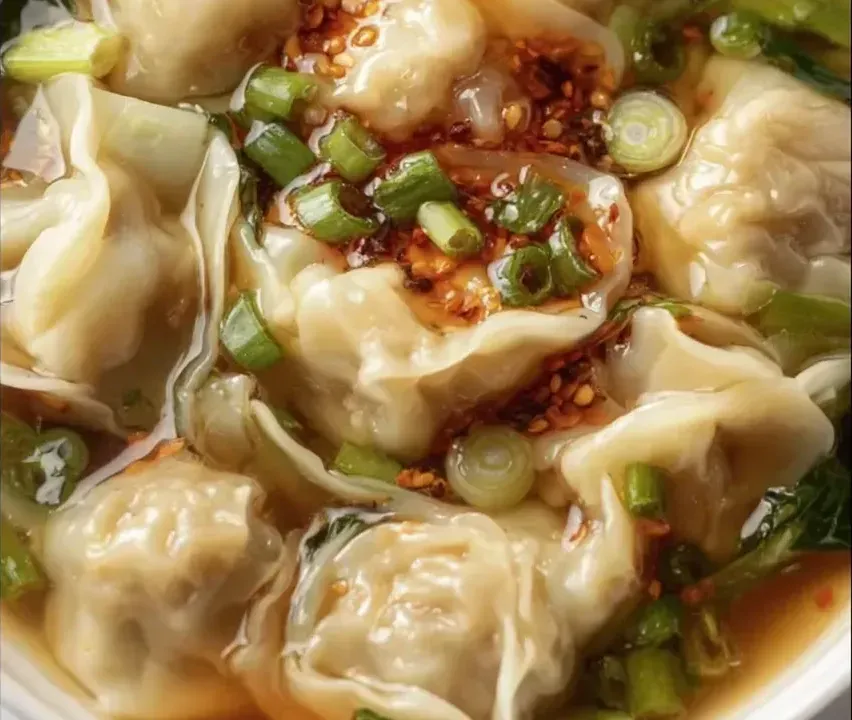
- Finished in the bowlSERVED IN THE CLEAR BROTH with the REMAINING GREEN ONION, 1 tbsp CHILLI OIL and 1 tsp SESAME SEEDS. The chilli oil is added at the end so it sits as red flecks on the surface rather than clouding the broth.
How to Make It
Pork mixed with green onion, soy, sesame, ginger and garlic
Mix the ground pork with half the green onion, the soy sauce, sesame oil, ginger and garlic.
A teaspoon per wrapper, edges moistened, folded loosely
Place about 1 teaspoon of filling in each wonton wrapper, moisten the edges, and fold loosely into simple wontons rather than tightly pleated potstickers.
Broth brought to a gentle boil, bok choy in for 2 minutes
Bring the chicken broth to a gentle boil with 1 tablespoon soy sauce and the rice vinegar. Add the bok choy and simmer 2 minutes.
Wontons simmered until translucent and 160°F inside
Add the wontons and simmer until the wrappers are translucent and the pork filling reaches 160°F, about 4 to 6 minutes depending on size.
Served in the clear broth with onion, chilli oil and sesame
Serve in the clear broth with the remaining green onion, chilli oil and sesame seeds.
Ingredient Notes
- Ground pork
- Eight ounces for twenty-four wontons. Ground pork is what sets the 160°F check.
- Square wonton wrappers
- Twenty-four, folded loosely. Thin wrappers are what turn translucent in the broth.
- Baby bok choy
- Two small heads, chopped. This is the leafy green in the soup.
- Chilli oil and sesame seeds
- A tablespoon and a teaspoon, spooned over at the end. The red flecks in the bowl are the chilli oil.
Why This Recipe Works
- Grated ginger and garlic season the pork evenly without leaving pieces in the filling.
- A teaspoon of filling per wrapper keeps the wontons thin enough to cook through quickly.
- Moistened edges seal the parcels so the filling stays inside the wrapper.
- A gentle boil cooks the wontons without tearing their thin wrappers.
- Adding the bok choy two minutes early means both it and the wontons finish together.
Success Tips
- Keep the stack of wrappers under a damp cloth so they stay pliable while you work.
- Press the air out as you fold, or the wontons will float before they are cooked.
- Check one of the largest wontons with a thermometer rather than judging by the wrapper.
Serving Ideas
Four bowls of clear golden broth with six loosely folded pork wontons each, chopped baby bok choy, sliced green onion, red chilli oil and a scattering of sesame seeds.
Frequently Asked Questions
What is in the wontons?
Ground pork seasoned with green onion, soy sauce, sesame oil, ginger and garlic.
How should they be folded?
Loosely, into simple wontons. Tight pleats would make them potstickers, which is a different dish.
How do I know they're cooked?
The wrappers turn translucent, and the pork filling reaches 160°F in the centre - usually four to six minutes.