
Ten ingredients and two and a quarter hours, most of it the dough rising.
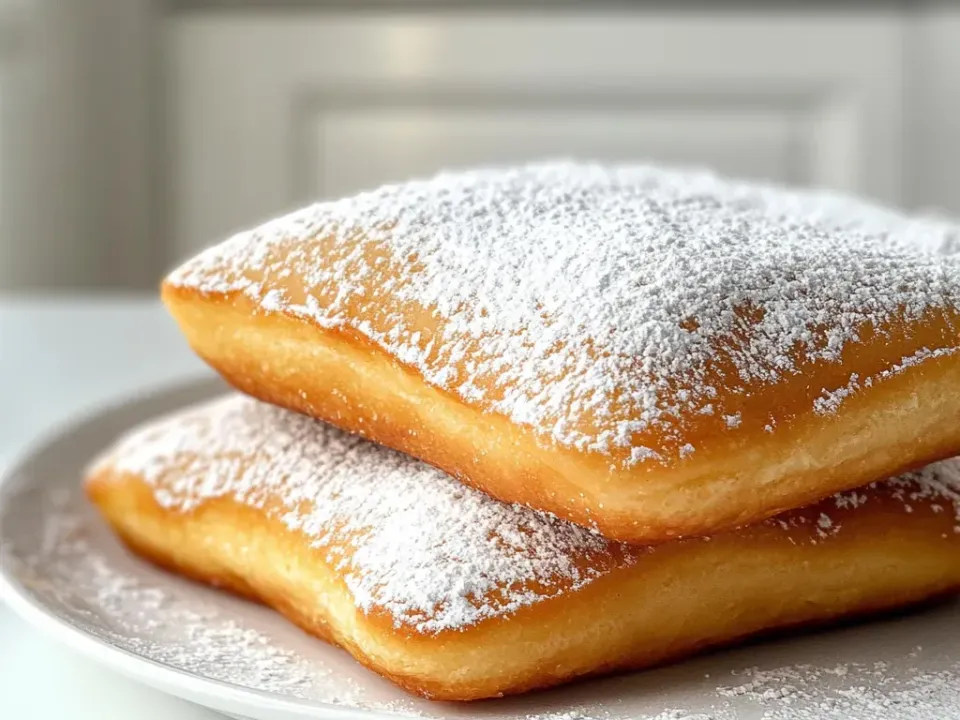
There is nothing inside a beignet here - no filling, no glaze, no sauce. The flavour is in the dough, and the finish is a heavy blanket of powdered sugar.
Why This Recipe Works
- Proofing the yeast in warm milk first confirms it is alive before it meets flour.
- Egg and melted butter make an enriched dough that fries soft rather than bready.
- Rolling to a quarter inch gives a square that puffs hollow in the oil.
- A short rest after cutting relaxes the squares so they puff evenly.
- Sugaring them warm is what makes the powdered sugar cling in a thick layer.
Ingredient Notes
- Vanilla extract
- Two teaspoons, whisked into the dough with the egg and butter. It is the only place the vanilla of the title can sit.
- Warm whole milk and active dry yeast
- Three quarters of a cup with a packet's worth. Warm, not hot — hot milk kills the yeast before it foams.
- Egg and melted butter
- One egg and three tablespoons. They enrich the dough, which is why it fries puffed and soft rather than dense.
- Powdered sugar
- A full cup, used generously. The finished beignets are meant to be buried in it.
How to Make It
Milk, yeast and a teaspoon of sugar left until foamy
Stir warm milk, yeast and 1 tsp of the sugar together and let stand 5 to 10 minutes until foamy.
Sugar, egg, vanilla and butter whisked in, flour kneaded to a smooth dough
Whisk in the remaining sugar, egg, vanilla and melted butter. Add flour and salt and knead until smooth and slightly tacky, 6 to 8 minutes.
Covered and risen about an hour until doubled
Cover and let rise until doubled, about 1 hour.
Rolled a quarter inch thick, cut into squares, rested
Roll the dough about 1/4 inch thick and cut into 2 1/2-inch squares. Rest 15 minutes.
Fried three or four at a time at 350°F, a minute or so a side
Heat 2 to 3 inches of oil to 350°F. Fry 3 to 4 pieces at a time for about 1 to 1 1/2 minutes per side, keeping the oil between 340°F and 355°F.
Drained briefly, buried in powdered sugar while warm
Drain briefly on a rack, then bury the warm beignets generously in powdered sugar.
One Number Decides Whether These Puff
A beignet is an enriched yeast dough and a pot of hot oil, and almost everything about the finished pillow - the puff, the colour, whether it tastes of oil - is decided by one temperature. The recipe gives a target and a window: 350°F, held BETWEEN 340°F AND 355°F. Before that gate is the dough; after it is the sugar.
- Prove the YEAST before trusting it3/4 cup WARM WHOLE MILK, 2 1/4 tsp ACTIVE DRY YEAST and 1 tsp of the SUGAR left 5 TO 10 MINUTES UNTIL FOAMY. Foam is the evidence the yeast is alive. If none appears, the milk was too hot or the yeast is spent, and nothing later can recover the rise.
- An ENRICHED dough - the VANILLA is hereThe rest of the 1/4 cup SUGAR, 1 EGG, 2 tsp VANILLA and 3 tbsp MELTED BUTTER whisked in, then 2 3/4 cups FLOUR and 1/2 tsp SALT KNEADED UNTIL SMOOTH AND SLIGHTLY TACKY, 6 TO 8 MINUTES, and RISEN UNTIL DOUBLED, ABOUT 1 HOUR. The vanilla of the title can only live inside the dough, because nothing else goes on these but sugar.
- A QUARTER INCH, 2 1/2-inch SQUARES, and a RESTROLLED ABOUT 1/4 INCH THICK, CUT INTO 2 1/2-INCH SQUARES and RESTED 15 MINUTES. Thickness is what lets the square puff into a hollow pillow; the rest relaxes the gluten so it puffs evenly rather than curling at the corners.
Check before you continue
350°F - held between 340°F and 355°F — A frying thermometer in 2 to 3 inches of oil
2 TO 3 INCHES OF OIL from the 2 qt of NEUTRAL FRYING OIL, heated to 350°F, and FRIED 3 TO 4 PIECES AT A TIME FOR ABOUT 1 TO 1 1/2 MINUTES PER SIDE, KEEPING THE OIL BETWEEN 340°F AND 355°F. Below the window the dough soaks up oil and stays pale and heavy; above it the outside browns before the inside cooks. Three or four at a time is what keeps the temperature in the window. For safety at this step: MAINTAIN FRYING OIL NEAR 350°F, DO NOT OVERCROWD THE POT, LOWER DOUGH AWAY FROM YOUR BODY, AND KEEP WATER AWAY FROM HOT OIL.
- DRAINED on a rack, brieflyA rack rather than paper lets the oil run off without the underside steaming soft. Briefly, because the sugar has to go on while they are warm.
- BURIED - and warm1 cup of POWDERED SUGAR, and the beignets BURIED GENEROUSLY in it while still warm. Buried is the word that matters: a heavy blanket, not a dusting, and warmth is what makes it cling.
- Nothing elseNothing else goes on: NO FILLING, GLAZE, FRUIT OR DIPPING SAUCE. 'French' in the name is a style word only, and no claim about where beignets come from is made here.
Success Tips
- Use a thermometer and keep the oil between 340°F and 355°F throughout.
- Fry only three or four at a time so the oil temperature holds.
- Sugar them while they are still warm; cooled beignets shed the coating.
Serving Ideas
Sixteen square beignets, puffed and golden at the edges, buried under a heavy blanket of powdered sugar and served warm.
Frequently Asked Questions
Should beignets be filled or glazed?
Not these. They are plain fried squares with vanilla in the dough and a thick coat of powdered sugar — no filling, glaze, fruit or dipping sauce.
What temperature should the oil be?
Heat it to 350°F and keep it between 340°F and 355°F while frying. Too cool and they absorb oil; too hot and they brown before the centre cooks.
Why didn't mine puff?
Usually the dough was rolled too thick, the squares skipped their 15-minute rest, or the oil was below temperature. A quarter inch thick and a hot, steady oil is what makes them puff hollow.