
Three pounds of chuck, three and a half hours at a low oven temperature, and a braising liquid that is half savoury and half sharp: beef broth against unsweetened cranberry juice and balsamic vinegar.
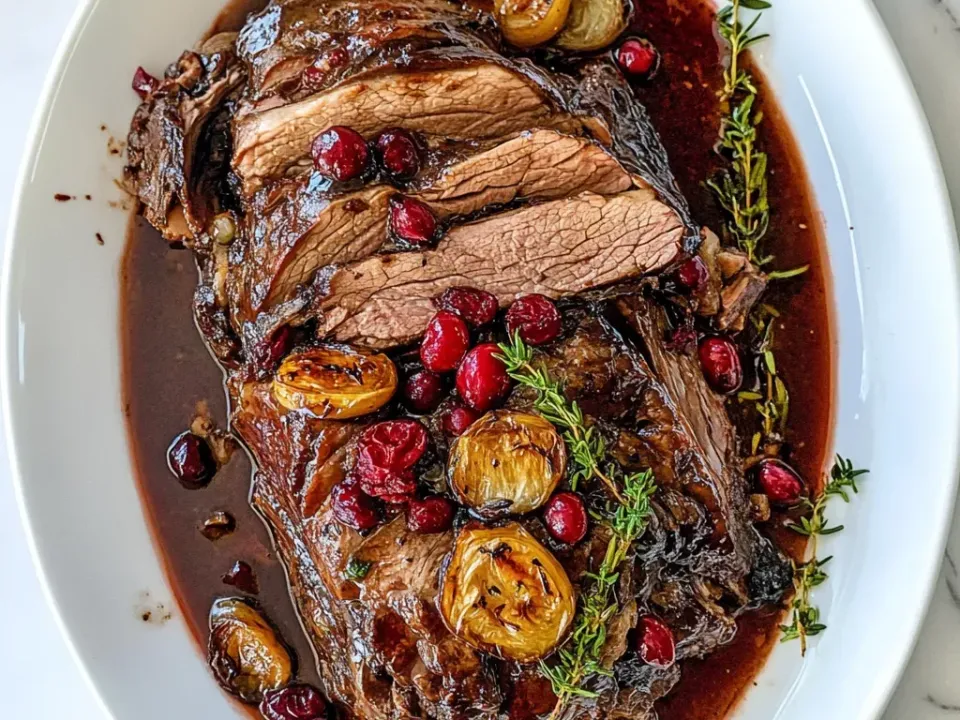
The whole cranberries and the halved shallots are not decoration. Both are visible in the finished dish and both have their own timing — the shallots browned at the start, the cranberries added at the two-and-a-half-hour mark.
Why This Recipe Works
- Browning three pounds of chuck deeply on every side builds the fond that the braising liquid later dissolves.
- A 325 degree Fahrenheit oven is gentle enough that three and a half hours breaks the connective tissue down without the meat drying.
- Tomato paste and brown sugar balance the acidity of cranberry juice and balsamic.
- Adding cranberries for only the last three quarters of an hour keeps them whole.
- Reducing the strained liquid at the end concentrates it into a glossy jus rather than leaving thin braising liquid.
Ingredient Notes
- Fresh or frozen cranberries
- A cup, whole, added with an hour to go. They are a defining visible part of the finished platter, which is why they are not put in at the start.
- Small shallots
- Eight, peeled and halved, browned before the liquid goes in. Halved rather than sliced so they hold their shape through three and a half hours.
- Unsweetened cranberry juice
- Half a cup. Unsweetened specifically — the tablespoon of brown sugar is the only sweetening the braise is meant to have.
- Cornstarch slurry
- A tablespoon slaked in cold water, and the recipe marks it optional. A well-reduced jus often needs nothing.
How to Make It
Oven on, roast seasoned
Heat oven to 325 degrees Fahrenheit. Season roast with salt and pepper.
Brown it deeply
Heat oil in a Dutch oven and brown the roast deeply on all sides; transfer to a plate.
Shallots, then the liquid
Brown shallots for 4 minutes, then add garlic, broth, cranberry juice, balsamic, tomato paste, brown sugar, and thyme.
Braise, then add cranberries
Return beef, cover, and braise 2 1/2 hours. Add cranberries and continue 45 to 60 minutes until the roast is fork-tender.
Reduce to a jus
Transfer beef and shallots. Simmer the braising liquid to a glossy red-brown jus; thicken lightly with cornstarch only if needed.
Slice and glaze
Slice or pull the roast, spoon over the cranberry-shallot glaze, and finish with fresh thyme.
What Goes In, and How Late
Nearly four hours, and almost everything is in the pot from the start. The one exception is the ingredient the finished platter is named for, and it goes in with an hour left.
0:00 - before anything else
3 lb chuck roast, salted with 1 1/2 tsp and peppered with 3/4 tsp, browned deeply on all sides in 1 tbsp olive oil, then out
Browned and removed. The roast comes back, but the pot is needed empty for what follows.
0:10 - four minutes on their own
8 small shallots, peeled and halved
Their own browning window before any liquid. Caramelised shallots are one of the two defining components, and they cannot caramelise once the pot is wet.
0:15 - the braise is built
3 smashed garlic cloves, 1 cup beef broth, 1/2 cup unsweetened cranberry juice, 2 tbsp balsamic, 1 tbsp tomato paste, 1 tbsp brown sugar, 4 sprigs thyme, and the beef returned
Sharp against savoury: cranberry juice and balsamic on one side, broth and tomato paste on the other, with a single tablespoon of brown sugar holding the middle.
2:45 - with an hour to go
1 cup fresh or frozen cranberries
The whole point of this timeline. In at the start they would dissolve; in for the last 45 to 60 minutes they cook through and stay whole, which is how they appear on the platter.
3:30 - out of the pot
Nothing. The beef and shallots come out and the liquid reduces to a glossy red-brown jus
1 tbsp of cornstarch slaked in cold water is available here and the recipe marks it optional - a properly reduced jus usually does not need it.
Success Tips
- Take the time on the browning — deeply on all sides is where the colour of the finished jus comes from.
- Keep the lid on for the first two and a half hours; the cranberries go in after it comes off.
- Reduce the liquid before reaching for the cornstarch, and add the slurry only if it still needs it.
Serving Ideas
Six servings on a white oval platter, the sliced or pulled roast under the dark red-brown jus with the whole cranberries and caramelised shallot halves over it and fresh thyme sprigs on top.
Frequently Asked Questions
Why not add the cranberries at the beginning?
Three and a half hours would break them down completely into the liquid. Forty-five to sixty minutes cooks them while leaving them whole, which is how the finished dish looks.
Is 145 degrees enough for the beef?
That is the USDA minimum for a beef roast, with a three-minute rest. This braise deliberately goes far past it, because fork-tender chuck needs hours rather than a temperature.
Do I need the cornstarch?
Only if the reduced liquid is still thin. The recipe marks it optional, and simmering it down is the first move.