
Thirteen items and fifty minutes, and it is a plated dinner rather than a platter.
The sauce is built in the pan the medallions came out of, while they rest their three minutes.
Why This Recipe Works
- Medallions give eight seared crusts where a whole roast gives one.
- Reducing the sauce in the searing pan picks up everything the beef left behind.
- Whole-grain mustard keeps its seeds visible where a smooth mustard would not.
- Butter at the end is what turns a reduction glossy rather than merely thick.
- Steaming the beans and only briefly cooking the peppers keeps both colours bright.
Ingredient Notes
- Beef tenderloin, cut into 8 medallions
- A pound and a half, cut into eight. Two per plate, each with its own seared crust.
- Whole-grain mustard with honey
- Two tablespoons of each. Whole-grain rather than smooth — the visible seeds in the finished sauce are part of what this dish looks like.
- Beef broth and butter
- Half a cup and a tablespoon. The broth reduces to amber and the butter is what gives it the gloss.
- Mashed potatoes, green beans and pepper strips
- Three cups, two cups and half a red and half a yellow pepper. Three sides, all on the plate, and the title names none of them.
How to Make It
Medallions seasoned and seared to 145°F, rested three minutes
Season tenderloin medallions and sear in oil until browned and the centers reach 145°F; rest 3 minutes.
Mustard, honey and broth whisked into the same skillet, finished with butter
In the same skillet, whisk whole-grain mustard, honey, and broth; reduce to a glossy amber sauce and finish with butter.
Green beans steamed, red and yellow pepper strips sautéed briefly
Steam green beans and briefly sauté red and yellow pepper strips.
Mashed potato spooned onto plates, beans and peppers alongside
Spoon mashed potatoes onto plates and arrange green beans and pepper strips alongside.
Medallions set over the potato, seeded sauce spooned broadly, thyme on top
Set beef medallions over the potatoes, spoon the seeded honey-mustard sauce broadly over and around them, and garnish with thyme.
Amber and Seeded, Over a Full Plate
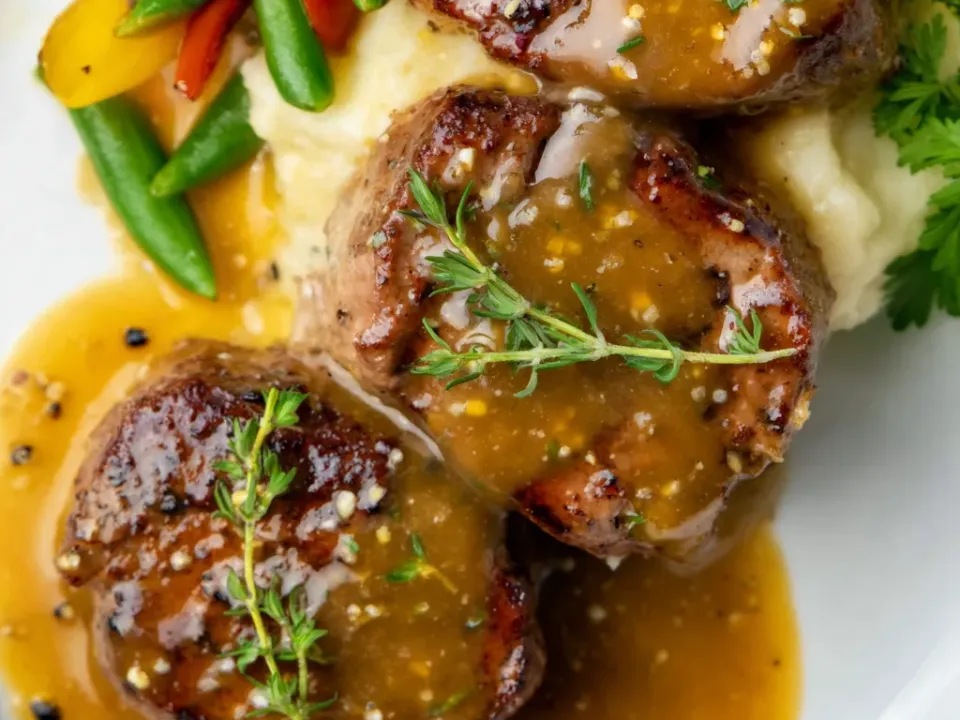
This plate is EIGHT INDIVIDUAL MEDALLIONS over MASHED POTATO with GREEN BEANS and PEPPER STRIPS alongside, under a sauce that is AMBER, GLOSSY and full of visible SEEDS. Every element below is part of that picture as well as an ingredient.
The FOND - left in the pan on purpose
Seared until browned and the centres reach 145°F, then rested 3 minutesWhat 1 1/2 lb of TENDERLOIN CUT INTO 8 MEDALLIONS leaves behind after searing in 1 tbsp OLIVE OIL with 1 tsp KOSHER SALT and 1/2 tsp BLACK PEPPER
The base of everything. Eight medallions present eight sets of cut faces to the pan rather than the single exterior a whole roast offers, so there is considerably more browning to deglaze. The sauce is built IN THE SAME SKILLET without washing it.
The MUSTARD - WHOLE-GRAIN, and this is visible
Whisked into the hot skillet2 tbsp WHOLE-GRAIN MUSTARD
The seeds. The sauce should have VISIBLE WHOLE MUSTARD SEEDS, and a smooth Dijon would give the same flavour with none of the texture or the look.
The HONEY and the BROTH - reduced to AMBER
Reduced until amber and coating2 tbsp HONEY and 1/2 cup BEEF BROTH
Colour and body. REDUCED TO A GLOSSY AMBER SAUCE - amber matters, and it comes from honey concentrating against beef broth rather than from any dairy. Reduce it far enough to coat and no further; honey turns bitter if pushed.
The BUTTER - last, and off the hardest heat
Whisked in to finish, off the boil1 tbsp BUTTER
The GLOSS. A reduction alone is thick but matt; butter whisked in at the end gives the shine the photograph shows on every medallion. This is the only dairy in the sauce and it is a tablespoon - not enough to turn it pale, which is exactly the point.
Then tasteThe plate is the other half of the identity. 3 cups of MASHED POTATOES SPOONED ONTO PLATES, with 2 cups of STEAMED GREEN BEANS and strips of 1/2 RED and 1/2 YELLOW BELL PEPPER BRIEFLY SAUTÉED and ARRANGED ALONGSIDE. Then the MEDALLIONS SET OVER THE POTATOES - over, so the sauce runs down into the mash - and the SEEDED HONEY-MUSTARD SAUCE SPOONED BROADLY OVER AND AROUND THEM so it POOLS WIDELY on the plate rather than sitting only on the beef. FRESH THYME SPRIGS to garnish. USDA gives whole-cut beef 145°F PLUS A 3-MINUTE REST, and medallions reach it fast.
Success Tips
- Sear the medallions in batches if the pan is crowded; steam costs you the crust.
- Build the sauce in the same unwashed skillet — that fond is half its flavour.
- Spoon the sauce broadly so it pools on the plate rather than only on the beef.
Serving Ideas
Four plates of two seared tenderloin medallions each over a mound of white mashed potato with steamed green beans and red and yellow pepper strips alongside, coated in a glossy amber whole-grain mustard sauce with thyme sprigs on top.
Frequently Asked Questions
What goes on the plate with the beef?
Mashed potato underneath the medallions, with steamed green beans and sautéed red and yellow pepper strips alongside. All three are part of the dish rather than optional.
Can I use smooth mustard instead?
The recipe calls for whole-grain. The seeds stay visible in the finished amber sauce, which is a large part of how this plate looks.
How done should the medallions be?
At least 145 degrees Fahrenheit at the centre, then rested three minutes before they go on the plate. Medallions cook fast, so check them early.