
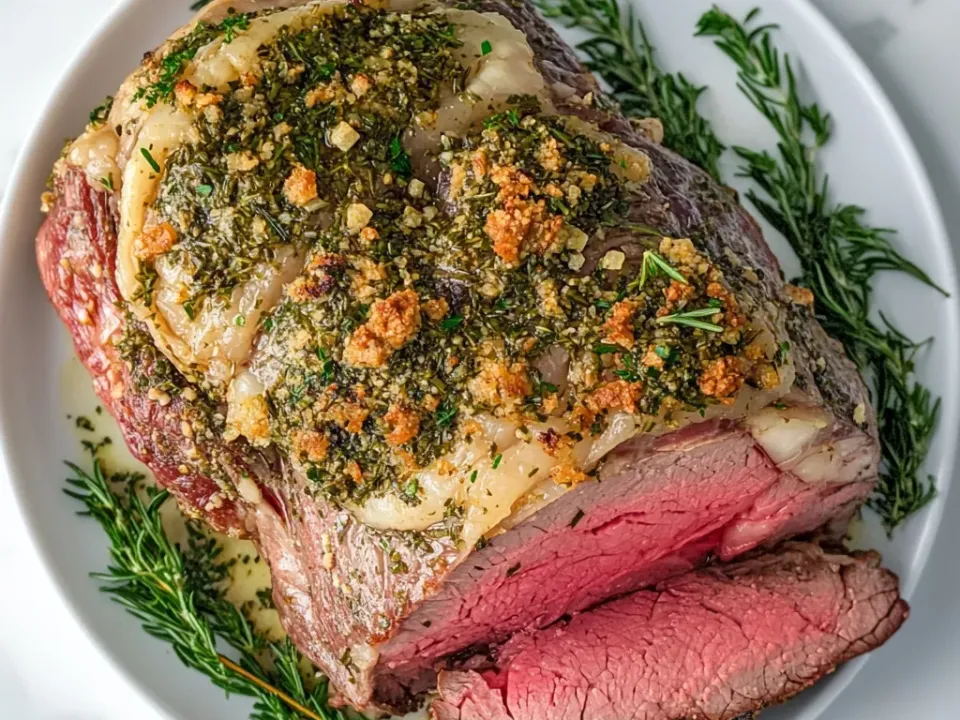
A five-pound bone-in prime rib rubbed with a paste of olive oil, five cloves of garlic, fresh rosemary and thyme, salt, pepper and a teaspoon of Dijon.
Twenty minutes at 450°F to set the crust, then 325°F until the thickest part reaches at least 145°F, and a twenty-minute rest before carving.
Why This Recipe Works
- The two-stage oven does two different jobs. The 450°F opening sets the herb crust and browns the fat cap; the long 325°F stretch brings the centre up gently, which is the only way a roast this thick cooks evenly.
- Dijon in the paste is a binder as much as a flavour. A teaspoon of mustard emulsifies the oil and holds the garlic and chopped herbs against the meat instead of letting them slide off in the first ten minutes.
- Fat-side up on a rack. The fat cap renders down through the roast as it cooks, and the rack keeps the underside out of the rendered fat so it roasts rather than fries.
- Fresh rosemary and thyme rather than dried. Twenty minutes at 450°F would scorch dried leaves; fresh herbs in an oil paste have the moisture to survive it.
- The recipe gives a wide time range on purpose. A rolled, thick roast and a long, thin one of the same weight can differ by half an hour, and the thermometer is the only honest instruction.
Seven Steps, Four Phases
This is a long recipe with very few ingredients, which means almost all of it is heat management. Two oven temperatures and one long rest, in that order, and none of the three is interchangeable.
Stage 1 of 4
Temper
Steps 1–1 of 7
Forty-five minutes out of the fridge. A five-pound roast holds a great deal of cold, and starting it from fridge temperature is the single most common cause of a grey band under the crust.
- Take it out of the fridgeRemove the roast from the refrigerator 45 minutes before cooking.
Stage 2 of 4
Crust
Steps 2–4 of 7
Oven to 450°F while the paste is made — olive oil, five cloves of garlic, rosemary, thyme, salt, pepper and Dijon — and rubbed over the roast. Fat-side up on a rack, so the fat bastes the meat as it renders and the underside is not sitting in liquid.
- Heat the oven highHeat the oven to 450°F.
- Make and apply the pasteMix the olive oil, garlic, rosemary, thyme, salt, pepper and Dijon into a paste and rub it over the roast.
- Set it on the rackPlace the roast fat-side up on a rack in a roasting pan.
Stage 3 of 4
Two-stage roast
Steps 5–6 of 7
Twenty minutes at 450°F to set the crust, then straight down to 325°F for the long middle: about one hour 45 minutes to two hours 10 minutes more, until the thickest part reads at least 145°F. Shape matters more than weight here, which is why the range is wide and the thermometer is the authority.
- Sear in the oven, then drop the heatRoast at 450°F for 20 minutes, then reduce the oven to 325°F.
- Roast to temperatureContinue roasting until the thickest part reaches at least 145°F, about 1 hour 45 minutes to 2 hours 10 minutes more depending on shape and oven.
Stage 4 of 4
Rest
Steps 7–7 of 7
At least twenty minutes on a board, loosely tented. Loosely — a tight seal steams the crust soft. Twenty minutes is far beyond the three-minute minimum the safe temperature requires, and it is what stops the juices running out at the first cut.
- Rest before carvingTransfer the roast to a board, loosely tent with foil and rest for at least 20 minutes before carving.
Ingredient Notes
- Bone-in prime rib roast
- About five pounds, bone-in. The bones insulate one side of the roast and slow it down slightly, which is part of why the time range in step 6 is as wide as it is.
- Garlic, minced
- Five cloves, minced fine. In a paste that spends twenty minutes at 450°F, coarse chunks scorch where fine mince toasts.
- Fresh rosemary and thyme
- A tablespoon each, chopped. Fresh rather than dried — the oil paste protects them, and dried herbs at 450°F simply burn.
- Dijon mustard
- A teaspoon, and it is structural. It holds the paste to the meat; without it the crust slides into the pan as the fat renders.
- Kosher salt
- Two teaspoons across five pounds. Kosher rather than table salt — the larger crystals distribute more evenly through an oil paste.
How to Make It
Take it out of the fridge
Remove the roast from the refrigerator 45 minutes before cooking.
Heat the oven high
Heat the oven to 450°F.
Make and apply the paste
Mix the olive oil, garlic, rosemary, thyme, salt, pepper and Dijon into a paste and rub it over the roast.
Set it on the rack
Place the roast fat-side up on a rack in a roasting pan.
Sear in the oven, then drop the heat
Roast at 450°F for 20 minutes, then reduce the oven to 325°F.
Roast to temperature
Continue roasting until the thickest part reaches at least 145°F, about 1 hour 45 minutes to 2 hours 10 minutes more depending on shape and oven.
Rest before carving
Transfer the roast to a board, loosely tent with foil and rest for at least 20 minutes before carving.
Success Tips
- Give it the full forty-five minutes out of the fridge before the oven goes on.
- Rub the paste over every surface, including the ends, not just the fat cap.
- Reduce the oven at exactly twenty minutes rather than opening the door to check.
- Put the thermometer into the thickest part, well clear of the bone.
- Tent the rested roast loosely; a sealed foil parcel undoes the crust in ten minutes.
Serving Ideas
A holiday centrepiece: roast potatoes, a green vegetable and horseradish or the pan juices. Carve at the table if you can — it is the whole reason for cooking a bone-in roast.
Storage and Reheating
Refrigerate
Refrigerate carved slices in an airtight container for up to 3 days, ideally with any resting juices poured over them.
Freeze
Freeze sliced beef for up to 2 months. Slices freeze better than a whole piece and thaw quickly enough to keep their texture.
Reheat
Reheat slices gently, covered, with a splash of stock at 300°F just until warm. Reheating hard cooks the beef a second time and takes it well past where it was carved.
Frequently Asked Questions
How long per pound should I roast it?
Weight is only a rough guide, which is why the recipe gives a range and a temperature. A thick roast takes longer than a long thin one of the same weight, so go by the thermometer.
Can I use a boneless roast?
Yes, and it usually cooks a little faster since there are no bones insulating one side. The same 450°F opening, the same 325°F finish and the same 145°F target apply.
Why rest it for twenty minutes?
A roast this size carries a lot of heat and a lot of juice. Twenty minutes lets both settle, so the slices stay moist rather than emptying onto the board at the first cut.
The herb crust came away when I carved it.
Usually a paste that was too loose. The Dijon and the two tablespoons of oil should make something that clings like a thick rub — if it pours, it needs more herb and less oil.